The ASPIRE Library
A quiet collection of texts that say something true about being human — about relationships, nature, meaning and loss. Not decoration. Each piece is here because it holds up in a counseling space.
N° 001 — Poetry
Khalil Gibran — The Prophet, 1923
Khalil Gibran (1883–1931) was a Lebanese-American writer, poet and visual artist. The Prophet, published in 1923, is his best-known work: a series of prose poems in which a prophet answers questions about life — love, work, freedom, pain, children.
In On Children, he describes the parent not as owner but as bow: the child is the arrow, and the task is to bend with love — and let go. It is one of the most honest texts ever written about relationships.
Why it stands here: much of what people bring into counseling is about holding on and letting go — of children, of parents, of roles, of how things were supposed to be. This poem says it in fourteen lines.
Gibran died in 1931. His work is in the public domain.
Your children are not your children.
They are the sons and daughters of Life’s longing for itself.
They come through you but not from you,
And though they are with you yet they belong not to you.
You may give them your love but not your thoughts,
For they have their own thoughts.
You may house their bodies but not their souls,
For their souls dwell in the house of tomorrow,
which you cannot visit, not even in your dreams.
You may strive to be like them,
but seek not to make them like you.
For life goes not backward nor tarries with yesterday.
You are the bows from which your children
as living arrows are sent forth.
More voices in the space
N° 002 — Poetry
“Hope” is the thing with feathers —
That perches in the soul —
And sings the tune without the words —
And never stops — at all —
N° 003 — Poetry
Do I contradict myself?
Very well then I contradict myself,
(I am large, I contain multitudes.)
N° 004 — A story
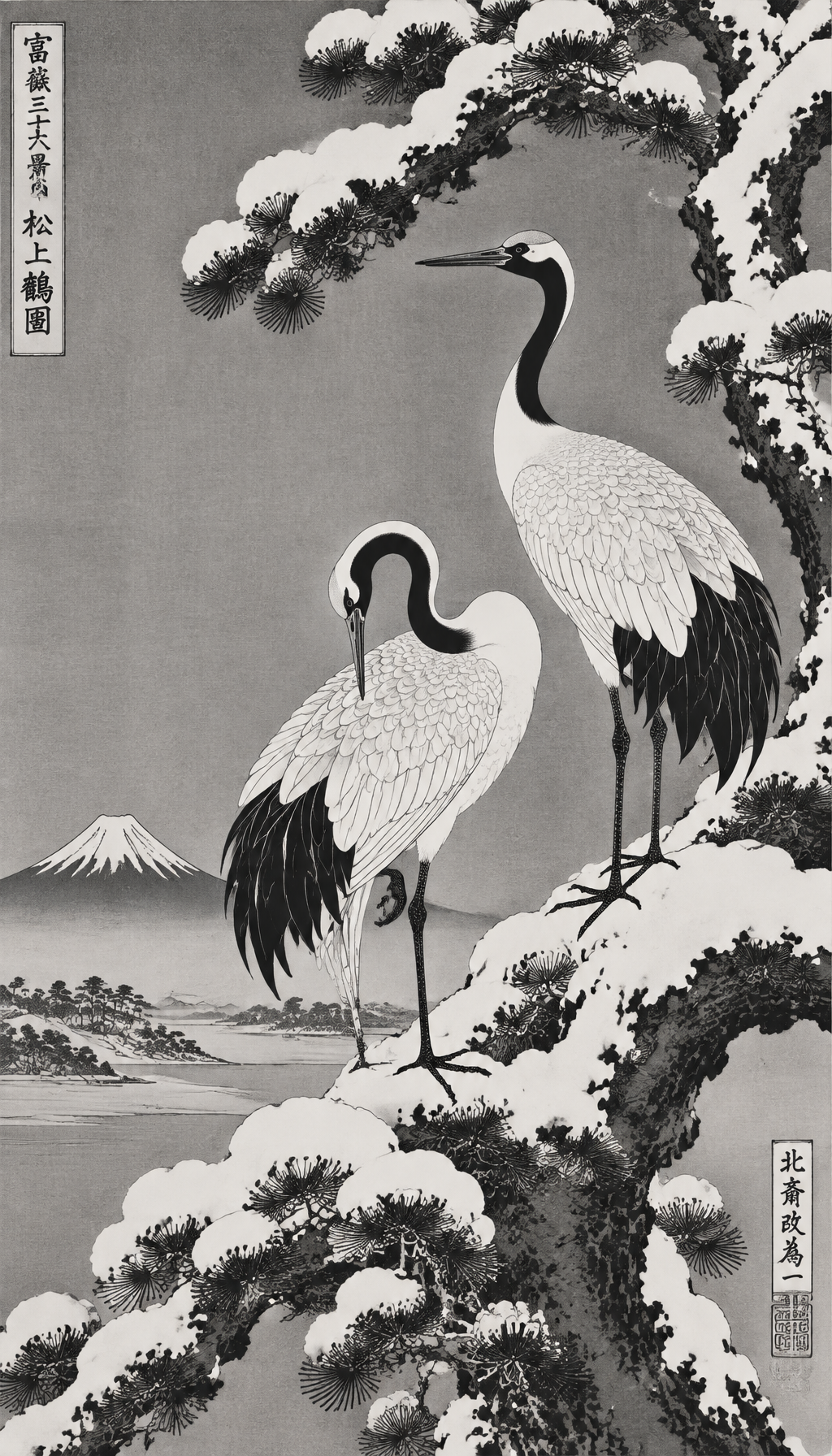
In Japan there is a tradition called senbazuru: folding one thousand paper cranes. The crane is said to live a thousand years, and whoever folds a thousand cranes is granted a wish — often health, or peace.
The story became known worldwide through Sadako Sasaki (1943–1955). She was two years old when the atomic bomb fell on Hiroshima, about a mile from her home. Ten years later she became ill with leukemia. In hospital she began folding cranes, hoping to reach one thousand. After her death, her classmates raised a monument: the Children’s Peace Monument in Hiroshima, where people from all over the world still leave strings of folded cranes.
Folding a thousand cranes is beautiful.
Or becomes a wish.
And to give one away is a small, quiet happiness.
In Brussels, artist and designer Charles Kaisin has used thousands of golden origami cranes in public installations — including a 40-meter golden Christmas tree made of 20,000 origami pieces at Galeries Royales Saint-Hubert, and a bird installation at Westland Shopping Center. His work turns a private wish into a shared, visible gesture.
That is why the story stays in the space. Not because grief needs a grand gesture, but because some things are too big to carry alone. A thousand cranes is one way of keeping going — fold by fold, person by person.

Two older voices
N° 005 — Philosophy
“If thou art pained by any external thing, it is not this that disturbs thee, but thine own judgement about it. And it is in thy power to wipe out this judgement now.”
N° 006 — Prose
“I went to the woods because I wished to live deliberately, to front only the essential facts of life, and see if I could not learn what it had to teach, and not, when I came to die, discover that I had not lived.”
N° 007 — Prose poem
Max Ehrmann — Desiderata, 1927
Max Ehrmann (1872–1945) was an American writer and attorney. He published Desiderata in 1927, a short prose poem that became famous in the 1960s and has since been read as a quiet manual for living with uncertainty.
The Latin title means things desired. The text does not promise that life will be easy. It asks the reader to move gently through it — to speak clearly, listen well, enjoy achievements and plans alike, and above all to be gentle with oneself.
Why it stands here: many people come to counseling not because they are broken, but because they are tired. Ehrmann’s lines offer a kind of permission — to rest, to be quiet, to let the world be loud while you find your own pace.
Ehrmann died in 1945. The text is in the public domain.
Go placidly amid the noise and the haste,
and remember what peace there may be in silence.
As far as possible, without surrender,
be on good terms with all persons.
Speak your truth quietly and clearly;
and listen to others, even to the dull and the ignorant;
they too have their story.
Enjoy your achievements as well as your plans.
Keep interested in your own career, however humble;
it is a real possession in the changing fortunes of time.
Be gentle with yourself.
And whatever your labors and aspirations,
in the noisy confusion of life, keep peace with your soul.
With all its sham, drudgery, and broken dreams,
it is still a beautiful world.
N° 008 — Haiku
Matsuo Bashō (1644–1694) — c. 1686
Matsuo Bashō was a Japanese poet and travel writer, widely considered the master of haiku. His poems often hold a single moment still — a sound, a season, a small event — and let the reader rest inside it.
The old pond is his most famous haiku. A quiet surface, a sudden splash, then silence again. Nothing is explained; the poem simply points to presence.
Why it stands here: counseling is not always about filling the silence. Sometimes it is about sitting with it until something moves — a word, a feeling, a thought — and then noticing what remains.
Bashō died in 1694. This translation by Basil Hall Chamberlain is in the public domain.
The old pond...
A frog jumps in:
— splash! silence again.
Next in the library
“Work is love made visible.” — on meaning in what we do every day.
Khalil Gibran — forthcoming
On pain as the breaking of the shell that encloses understanding.
Khalil Gibran — forthcoming
On giving as something we do for ourselves as much as for others.
Khalil Gibran — forthcoming
Some things are easier to read than to say out loud. Talking about them is a next step.
Talk to ASPIRE